 Buildings need routine check-ups to pinpoint if and where energy is being wasted. Energy assessments and/or energy audits help building owners and operators understand how their building is using energy and areas for improvement.
 -
The insights gained from audits help building owners and operators develop effective decarbonization strategies, which may include electrifying systems and equipment and transitioning to renewable energy sources.
The Maryland Clean Buildings Hub (the Hub), an initiative of the Maryland Energy Administration, empowers Maryland’s building owners to make well-informed energy investments in their properties by connecting them to financial, educational, and technical assistance. Sign-up for the Hub newsletter here. Have questions? Contact [email protected].
|
Assessments & Check-Ups |
An energy assessment or check-up is typically quicker and less comprehensive than an energy audit, usually resulting in quick equipment swap-outs (e.g. installing a low-flow showerhead or LED bulbs) and a high-level summary of areas for improvement.
Throughout an Assessment, Energy Auditors Will:
-
Provide an overview of the building’s energy use
-
Pinpoint where it’s wasting energy
-
Flag any safety or health issues
-
Identify energy-saving opportunities
An energy audit typically consists of a systematic inspection of energy-consuming systems and equipment, data collection, analysis, and the creation of a detailed energy audit report. The main outcome of an energy audit is a list of recommended energy efficiency measures (EEMs), their associated energy savings potential, and an assessment of whether EEM installation costs are a cost-effective financial investment for a building owner.
American Society of Heating, Refrigerating and Air-Conditioning Engineers (ASHRAE) Audit Guidelines:
- Three levels of audits for commercial buildings.
- As audit complexity increases, so does the thoroughness of the site assessment, the amount of data collected, and the level of detail provided in the final audit report.
- More comprehensive and rigorous audits often translate into higher energy savings and related emissions reductions.
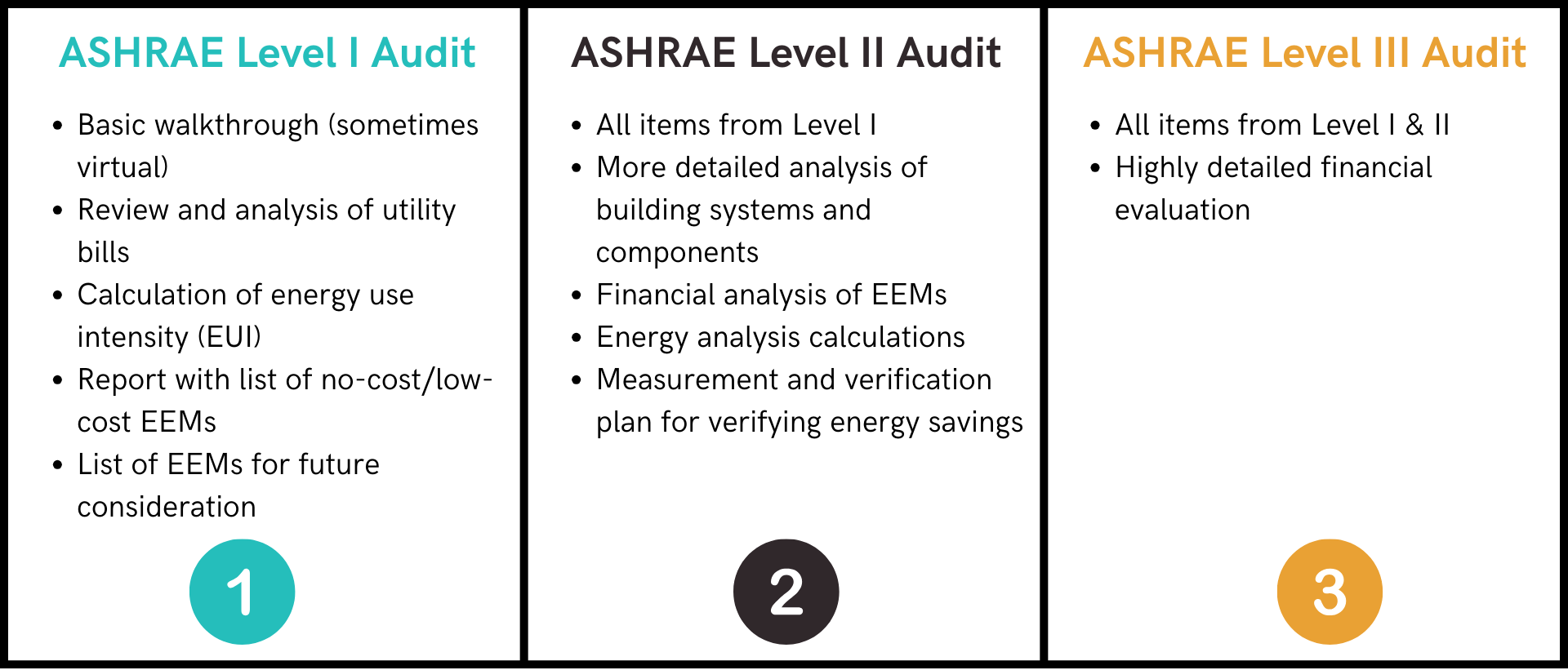
Each building is unique, and therefore the owner will need to determine which type of audit is best-suited for their building. A proper energy audit will provide a balance between energy audit cost and value.
Level II & III Audits:
- More expensive, but good options for building owners with defined energy goals or with plans for a major renovation or equipment upgrade.
-
These audits should include a preliminary feasibility study (often provided by potential energy auditors free of charge) to scope the energy saving opportunities and ensure the cost of the energy audit is worth the savings payoff.
Preparing for an Assessment or Audit
|
Energy assessments and audits are conducted by professionals who have industry-recognized credentials. Selecting a certified energy auditor assures you that the auditor is uniquely skilled and qualified to perform energy assessment work.
When Choosing a Vendor:
- Get several references and contact them all - ask if they were satisfied with the work.
- Make a list of any existing problems such as condensation and uncomfortable or drafty rooms.
- Have copies or a summary of the building’s yearly energy bills (your utility may be able to provide these or you may be able to get them online).
Maryland’s building owners and operators can tap into a range of federal, state, utility, and local incentives to help defray the costs of energy assessments and audits. The Maryland Clean Buildings Hub (the Hub) is committed to help building owners and operators understand the range of incentives that they may be eligible to receive.
State & Local Programs:
Baltimore Gas & Electric:
Delmarva Power:
Pepco:
-
Facility Energy Decision System (FEDS): FEDS is a tool that can help building owners identify the buildings to prioritize in a portfolio or on a campus. FEDS is free for state-owned facilities. Commercial building owners can use FEDS for a fee.